
Journal · 4 min read
Your morning run is your best light of the day.
You track your steps, your macros and your sleep. There's a fourth leg on the chair that almost nobody measures: light.
Journal · 4 min read
You track your steps, your macros and your sleep. There's a fourth leg on the chair that almost nobody measures: light.
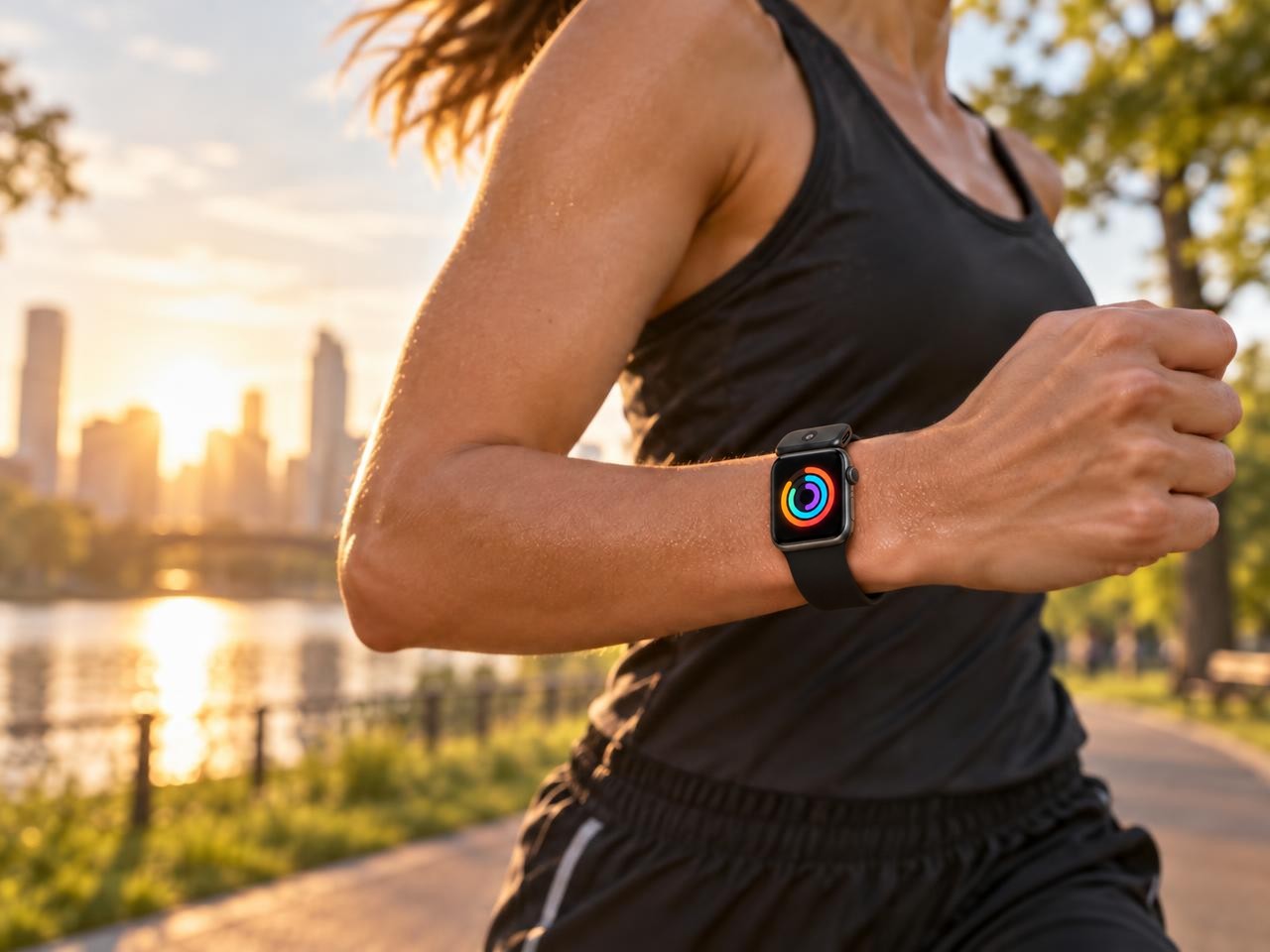
The fitness wave taught a whole generation to care about what they eat, how they move and how long they sleep. Good. But your body clock runs on light. It's the signal that tells it when it's day, when to be alert — and, many hours later, when to wind down and sleep.
A bright office is a few hundred lux. Outside, even on a grey morning, you're often in thousands — on a clear day, tens of thousands. That's why a 30-minute run or walk in the morning can deliver more useful light than a whole day at your desk.
Sleep and light researchers recommend at least 250 lux melanopic EDI during the day, and keeping it very low in the hours before bed. (Brown et al., 2022) Melanopic EDI is the part of light your body clock responds to — which is why light is more than lux, and why a normal lux app on your phone can't tell you much.
OcuWEAR reads the full spectrum of the light around you every few seconds — strength, colour and the melanopic part — and the app turns it into one simple number: how much of the light you needed did you get? On your collar, on a sports strap or on top of your Apple Watch, it sees roughly what your eyes see.
A light sensor needs light. Under a sleeve, in a pocket or under the desk, it measures darkness. When that happens, Ocutune's AI takes over: it uses your location and a precise local weather forecast to estimate the light you were most likely in. You'll get a reasonable value — not a perfect one.
A day with two covered spells
75% measured · 25% estimated
Your location
Where you are, and when the sun rises and sets there.
Precise forecast
Cloud cover hour by hour, so a grey morning isn't counted as a sunny one.
Your history
How much light usually reaches you at work, at home and on the move.
So the rule is simple: keep the sensor visible — also at work. Clip it on the outside of your collar, wear it on top of the strap, and push your sleeve up when you head out. The more the sensor sees, the less the AI has to guess.
The same goes for office work. Type, turn your palm up, rest your chin on your hand — and the sensor on your wrist suddenly points at the desk, the ceiling or your sleeve instead of where your eyes look. It then doesn't see quite how much light reaches you, or where it comes from.
That's why Ocutune doesn't trust every single reading. The watch knows how your wrist is turned, so readings taken at an odd angle can be weighted down and filled in from the moments the sensor faces the room — together with your location, the weather and your own history. A worn sensor gives a good picture of your day, not a lab measurement of every second.
Not medical advice. Examples and numbers in this article are illustrative.